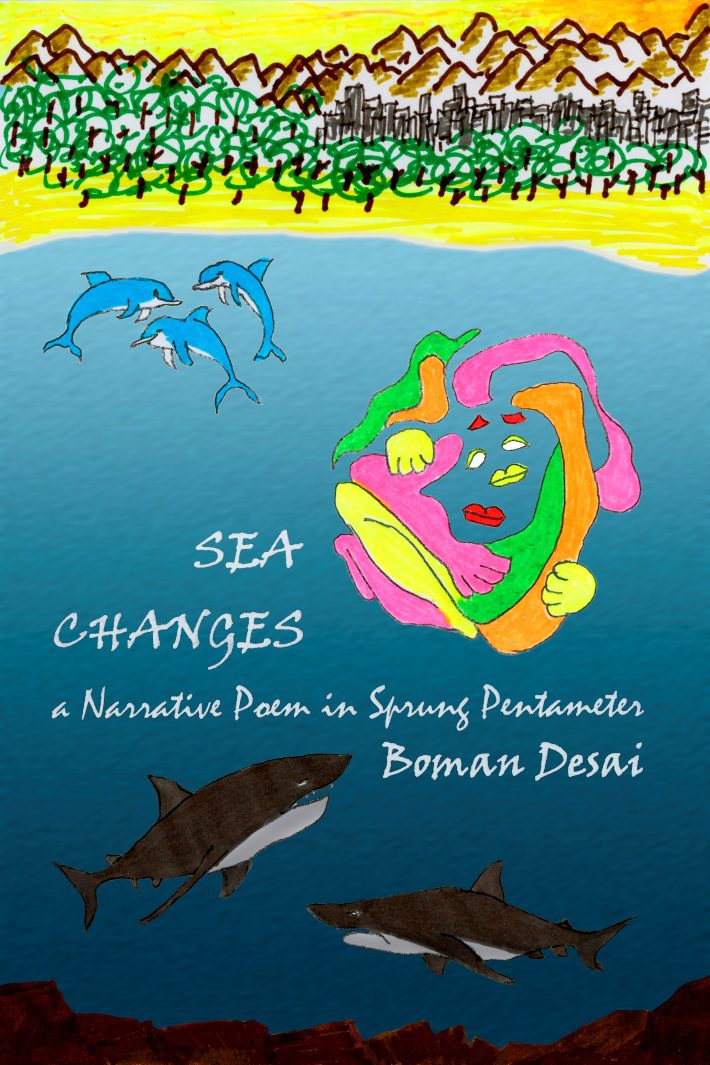
SEA CHANGES
A Narrative Poem in Sprung Pentameter
Wayne Jones and Elaine Jones (unrelated), in their late 20s, are still undergoing growing pains. They come together through mutual need (loneliness/physical attraction), but recognize almost immediately that mutual need is not enough, that they have succeeded only in cheating themselves. He’s a carpenter, poetry his north star, the world his subject matter. She’s a secretary, fresh from a bad marriage, suspicious of men who use poetry to cover shortcomings. Both are looking for diversion. It’s a coming-of-age story, brimming with home-truths—but the Epilogue deepens the coming-of-age theme to another, more profound: how to live a good life. Despite the interest of the narrative, its more unusual merit is its format: a new approach to meter and to rhyme—about which, more later.
The poetic approach makes the ambitious work consistently engaging to read (and, as Desai rightly points out, to read aloud). The author offers many rich details about the two lovers and the arc of their relationship. An intriguing … love story.
Kirkus Reviews
Author Boman Desai has painted a lush, evocative, and complex story with a language that is a work of art in itself. His use of sprung pentameter, a form I was not familiar with, is a joyous revelation, with its leaps, strolls, and somersaults that draw the reader into Wayne and Elaine’s hopeful, passionate, and conflicted romance.
RSK
BACKGROUND
At barely 60 pages, Sea Changes is easily my shortest book, but took the longest to find its way into the world, longer even than my 800-page opus, TRIO, in large part owing to its format. I wrote the story in prose in about a month in 1979. For want of a better word, we may call it a “relationship” story, but I had written “relationship” stories before and didn’t want to repeat myself unless I could make it somehow different. I tried writing it in blank verse (too formal), free verse (too free), and sprung rhythm (as defined by Gerard Manley Hopkins), setting it aside everytime I started a new work, even publishing novels in the interim, but everytime I completed a novel I came back to Sea Changes to see how else I might raise its merit.
All the twists and turns are neither interesting nor even necessary to appreciate the poem. I have included a Note in the book to light the labyrinthine path I traveled before discovering Sprung Pentameter (and, later, a new approach to rhyme). For instance, while “curiosity” and “city” satisfy the conventional requirement of a rhyme, “ity” being the rhyming syllables, it is a soft rhyme, not a hard rhyme such as “luminosity” and “curiosity,” or “pity” and “city.” The stress in “curiosity” is on “oss,” and in “city” on “cit.” “Oss” and “cit” are not rhymes, but centuries of usage have inured readers to soft rhymes. Rhyming syllables for “oss” in “curiosity” would be found in “blossom,” “imposter,” “posse,” and “jostle” (among others), each taking “oss” for its root sound. Similarly, rhyming syllables for “city” would be found in “Britain,” “critic,” “grit,” “glitter,” “little,” or “Hitler” (among others), each taking “itt” for its root sound. To take another example, “Elizabeth” is similarly linked to “lizard,” “dizzy,” “business,” “prism,” “Ms.,” “his,” “quiz,” and “risible” among others. To sharpen the point: if we call such linkages Correspondences, then “Peter” and “sweeter” are rhymes—and “Peter” and “sweetheart” are Correspondences, but not rhymes. Incidentally, “Peter” and “sweeter” are also Correspondences—but that, as I said, welcome though the rhyme may be, is incidental.
There is a great deal more to this gestation of 45 years, but I would recommend reading the work itself first, reading it out loud (at least, under your breath), because the sound of the words is as important, if not more, than the meaning—at which point the concluding Note on the form will mean a great deal more. I am happiest with the Epilogue, written in 2024, when I finally knew just what I was doing.
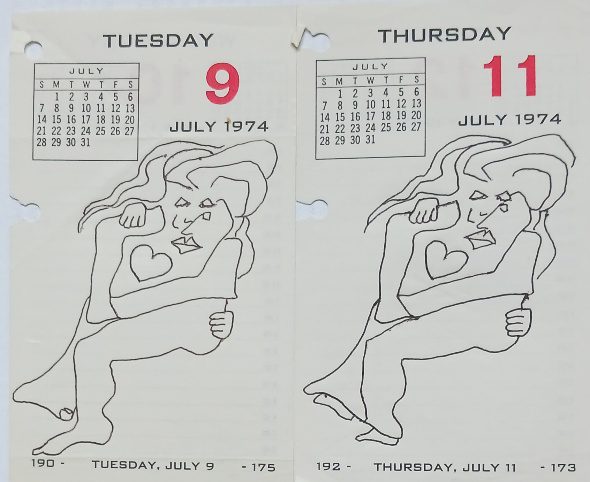
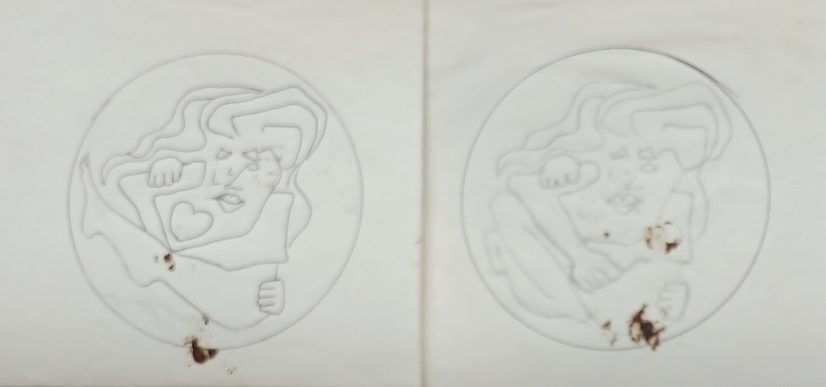
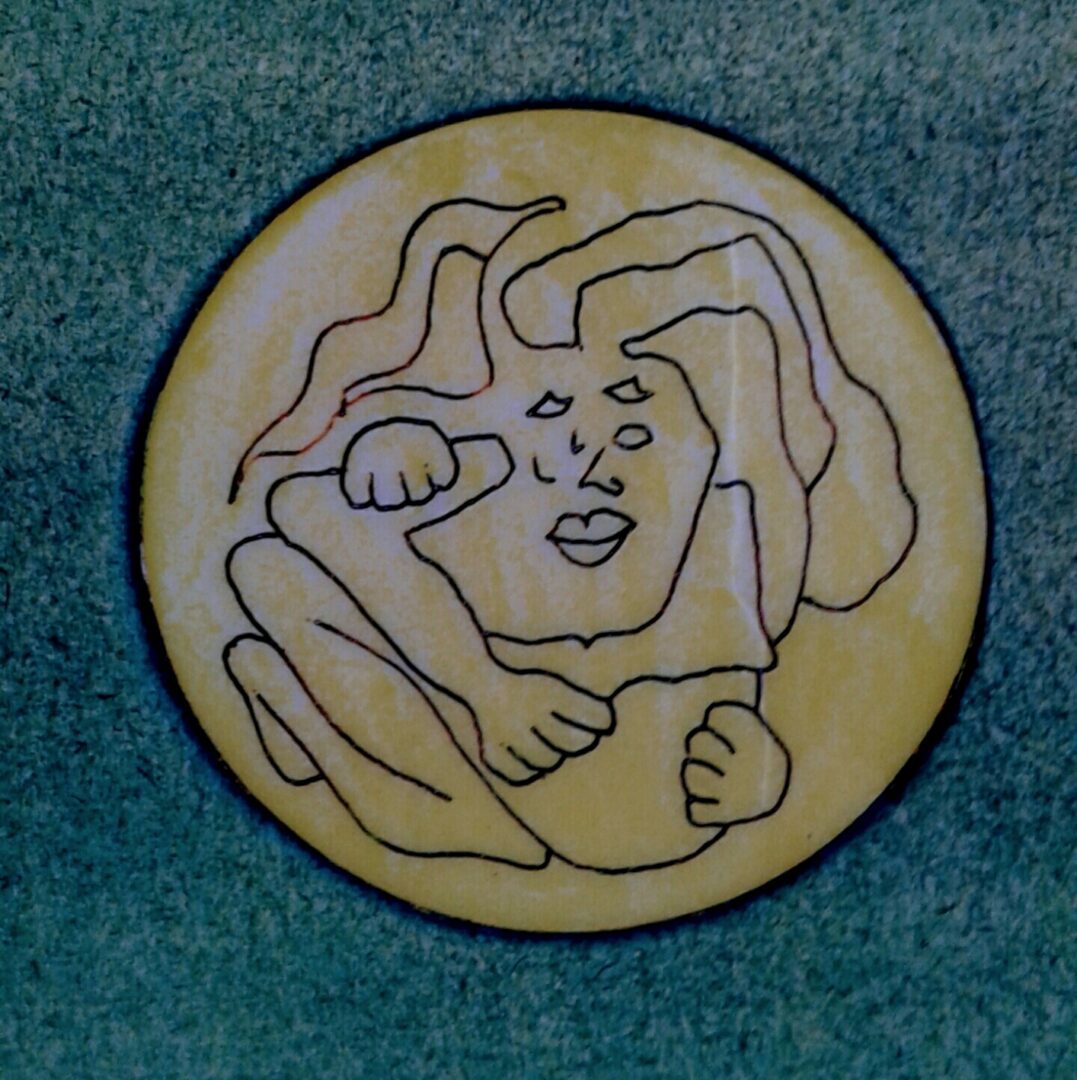
The evolution of the sketch of the lovers on the cover is a story in itself, but the images, above and below, tell the story best. It started as a doodle on my desk calendar on Tuesday, July 9, 1974, only to be continually revised to provide the final image.
EXCERPTS
One
She’s heard poets / are ramblers and gamblers, faring sadly in the aisles / of the world, creeping in the margins, sleeping in gutters, / charging where angels dread to tread for timeless / utterances, more lovers and writers and loners than fighters, / but sound where it matters, churls discovering pearls / in language more grand than earls discovering distant / lands.
Two
After numberless attempts / to submerge into slumber he throws off the covers. She’s still / umbilical, still umbrellaed, more mothered than mothering; / her thighs are firm and lovely to touch, skin like / pearls to his fingers; her belly’s still lean, as if / she were still in her teens; and her breasts, cast in grey / by the night, peep from their fold like fledglings still / to be weaned from the nest. She tempts him still, from her head / and shoulders to her knees and toes, but such invulnerabilities / get duller with years and infirmities get dearer, and lovers / who blind themselves to appearances find themselves / steadily deeper in love.
Three
He detests the typecast image: tired Jim / and dim Martha sitting by a fire, pipe / and newspaper, recipes and knitting, kiddies in the midst— / but absence makes a relentless heart relent; / refusing to bend he’ll break; certainly he’ll lose her. / Do doctors discuss medicine at the hearth? do industrialists / debits and credits? physicists nuclear fission?— / but poetry’s more pertinent to the hearth of the poet than medicine / to the doctor’s; more than an occupation, more than a habit, / poetry’s a vocation—but a hazardous vocation, not / for the soft of heart: for rebels, outcasts, outsiders— / but is it for him, this hatching of rhymes to scratch / an itch, stitching words to words in this trifling / mime of life? and there’s allegedly more / to life than poetry. Besides, a poet’s often / without recognition till he’s dead, and maturity’s measured / not by credits in the ledger of the world but by love, / a measure he’s regarded guardedly too long, / questioning too long her affection.