BRAHMS COMES TO DINNER
In the last fifteen years of his life, Johannes Brahms was the lion of Vienna, feted as the greatest living composer, someone who could do no wrong. The only person who dared criticize him and his work was Clara Schumann, the greatest woman pianist of the nineteenth century, the only woman Brahms had ever loved—to whom, and to whose husband, Robert Schumann (long dead at the time of the story), Brahms was greatly indebted. Despite his rise from the depths of Hamburg’s dockside bars to the elite of Vienna, Brahms never lost the touch of the peasant he had been born, alienating many good friends, resenting the privilege into which they had been born, not even recognizing his resentment.
A dinner party, such as many Brahms attended in the last decade of his life, threads the entire narrative. The scene covers a single evening in October of 1892, but the story extends from 30 September, 1853 (the day Brahms first called on the Schumanns) to 6 April, 1897 (the day of Brahms’s funeral). Nothing happens in the book that might not have happened historically—but when the historical record was less than forthcoming I felt comfortable imagining the scenes. I have mentioned these scenes in the Afterword and the reader is free to reimagine them or ignore them as she wishes.
Brahms is in a foul mood because Clara has withdrawn her friendship. They have not shared a cordial note for almost two years. She has put up with his multiple transgressions for a long time, almost since the death of her husband, forgiving him everything for his music—but, when he presumed to know her husband better than she did herself, she lost all patience. Not only does Brahms have difficulty admitting he’s wrong, but he blames her for his behavior, saying she had overlooked his tactlessness for years and there was no reason for her to stop now.
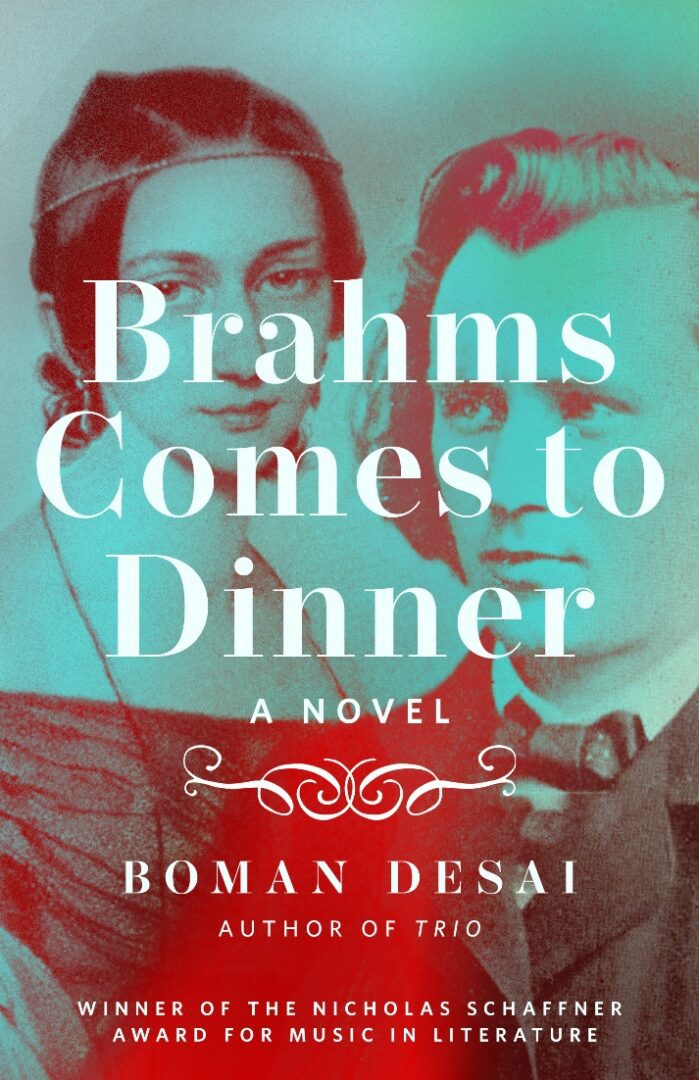
[T]he narrative moves forward, tracking the imbalanced romance between Brahms and Clara, the woman who knew how to bring his music to life, as well as how to bring out the best—and sometimes worst—qualities of Brahms’ oft-tortured soul. Written to prioritize historical accuracy and to capture the true voices of Brahms and Clara, Desai’s novel conjures the period and its characters to convincing … life…. Brahms fans will enjoy witnessing the man speak and flirt…. A faithfully rendered … historical novel about Brahms and his greatest love.
Kirkus Reviews
In Brahms Comes to Dinner, Boman Desai brings nineteenth-century Europe’s classical music scene vividly to life with lush prose and meticulous detail. His portrait of Brahms is rendered with tender humanity, capturing both his musical brilliance and his all-too-human flaws.
Aaron Hamburger, author of Hotel Cuba
I have been interviewed before, but by no one as attuned to her interviewee as Leah Roseman. She knew when to speak, when to listen, and could not have been more organized and prepared with questions and probes. I trust my viewers and readers will enjoy the interview almost as much as I did (they couldn't enjoy it more).
https://www.leahroseman.com/episodes/boman-desai(opens in new tab)
BACKGROUND
Brahms Comes to Dinner was adapted from the mothership of TRIO, a much larger book which I call a novel biography: a novel for people who hate novels (who read about only “real” things) and a biography for people who hate biographies (for the footnotes, commentaries, and speculations). I wrote what I knew, I researched what I did not know, and I imagined what I could not research. TRIO was as complete a biography of the Schumanns and Brahms as I wished to write, related in the form of a novel (dialogue and scenes filched, for instance from the correspondences and diaries), but when I first approached agents and editors with my mammoth manuscript I was told there was no appetite in the US for so large a book (1,800 pages of typescript) about classical music. It did no good to say it was about so much more, a narrative of love, insanity, suicide, history, revolution, politics, and war. The gatekeepers refused even to look at the manuscript unless I cut it to the more conventional 300 pages, but I had come too far to crawl back. I chose to publish it myself (to a hugely gratifying response)—and having published the manuscript to my satisfaction I remembered what the nest of agents and editors had said, and felt comfortable adapting it to their conventional request. They were right from their perspective: the book won the Nicholas Schaffner Award for Music in Literature and was published by the Schaffner Press.
EXCERPTS
One
The Baroness Gisela Bachrich, a divorced woman of forty years, dark eyes, gown of sable, diamond barrette clasping raven hair, diamond necklace drawing attention to her décolletage, threaded her way toward Brahms, her face aglow with her smile. “I was unavoidably delayed, my good Herr Doktor, but do not tell me that I have missed your performance.”
Brahms grunted. She leaned forward as she got close, enveloping him in a fragrance of jasmine, warmth of her body, touching his sleeve. He noted her expanses of rich white skin with a pang, bare shoulders, tendrils of fashionably escaped hair. He had met her before, introduced as he was to a steady stream of available women, not only divorcees and widows, but women half his age, and not only for purposes of marriage—but he avoided them all. He had once confided to Bulow that he had never made a respectable woman unhappy. However inviting, however accessible they appeared, he found himself hopeless. Flirtations were easy, followups impossible.
The Baroness’s smile was so brilliant the rest of the room seemed to fade. “I am told, Herr Doktor, that I resemble Emilia Rontgen. Do you not find that it is so?”
Emilia Rontgen was an actress, renowned for her roles onstage and off, also for her beauty. Brahms gripped his champagne goblet tightly. It was already his third of the evening, perhaps his fourth. “Ja, indeed, I do.”
The Baroness nuzzled her hip against his. “Do you really?”
Brahms laughed again, backing away. “Ja, really. I simply cannot tell the two of you apart. When I am next to one of you, I invariably wish it was the other.”
Two
Brahms’s sister, Elise, was twenty-three, her face plump, hair parted down the middle, cut like a bowl around her ears. Her mother, Christiane, scolded. “Elise, you too! Look busy!”
Elise scowled. The rooms had been dusted, swept, and scrubbed. She had sat in her dress all morning, not allowed to move, not even to help with the cooking in case she spilled something on her clothes, all because her brother was bringing Clara Schumann to their home. Even the windows had been left open, despite the cold, so the rooms would not be humid from cooking, drenched with smells. “What should I do?”
“I do not care! Close the window! Smile!”
Elise deepened her scowl. “I cannot smile to order. I am not an actress.”
“Then think happy thoughts!” Christiane smiled. “You will soon be seeing someone famous in your own home.”
Elise dropped her head, a smile began to appear.
Three
The last time Brahms attended a performance of his Fourth Symphony, the conductor called attention to his box after each movement. He had expected the final ovation, but not the downpour. He stood once more to acknowledge the applause, but fifteen minutes later he still stood, they still applauded, the downpour swollen to a monsoon. He was tired, wished to sit, but wished no more to leave than they, his lovely Viennese, wished to let him go, eyes no less damp than his own. All knew it was to be the last time.
What did it all mean? What did it matter what it meant? That was not the question. He had done what he had to do. Bismarck had done it with blood and iron, Goethe with ink and scribbles, he with sounds snatched from the air. Some said he had discovered a calculus for rhapsody. Clara had said that when she performed she had no more tears. It was the same for him when he composed. Sick with cancer, his liver foraged by bacteria, he remained standing, supported by the applause, the love, clinging to the rail, tears streaming in bright sheets down his cheeks, glistening like diamonds in his beard.
He died less than a month later, but what remained—the residue, the essence, distillate of his life, gold from straw—remains impervious to fang and claw, at once the heart of the riddle of life and medicine for the heart.